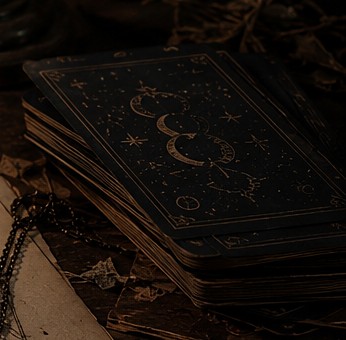
I can always tell when the Tower lands. The querent's eyes go to it first, before I have said a word, because everyone has absorbed the same idea from somewhere: that this is the bad card, the disaster card, the one you hope not to see. Readers apologise for it. Some decks soften it. And all of that dread rests on a misreading so complete that undoing it changes how the whole deck speaks.
Look at what is actually painted. In the old Marseille pattern the card is called La Maison Dieu, the House of God. Lightning strikes a tower, a crown is knocked from its top, and two figures fall, or leap, toward the ground. In the Waite Smith image the sky is grey, the flames are bright, and the crown tumbles whole. Nothing on the card judges anyone. There is no devil here, no sword of justice, no scales. There is a structure, a bolt of light, and people leaving.
What the machinery says
The esoteric tradition read it precisely. In the Golden Dawn's Book T the trump is titled the Lord of the Hosts of the Mighty, assigned to Mars, and set on the Hebrew letter Peh, which means the mouth. Sit with that for a moment. Under all the fire, this is a card about speech: the word that cannot be unsaid, the truth that finally comes out of the mouth and brings the arrangement down. Anyone who has lived through the sentence that ended a marriage, or the one that ended a job, knows exactly what weather this card describes.
And the lightning matters. In older symbolism the descending flash is not wrath but illumination, the sudden arrival of truth from above. The tower is struck because of how it was built: crown at the top, authority resting on masonry instead of ground. What falls is the arrangement, not the person. The figures are not dying. They are exiting a burning building, which is the sanest thing anyone does all deck.
How it reads in practice
In thirty years of reading I have watched this card name redundancies, diagnoses, divorces, bankruptcies and one memorable house sale. I have also watched the same querents come back a year later and call it, almost word for word, the best worst thing that ever happened to them. The job was already dead. The marriage was already over. The Tower did not do that. The Tower is the moment the lie stopped being load bearing.
Which is not permission to gaslight anyone, including yourself. When this card is live, something real is lost and the grief is real, and a reader who chirps about growth opportunities while the roof is on fire deserves to be shown the door. Both things are true at once: it hurts, and it frees. Honest reading holds both without dropping either.
When it comes up for you, ask the working questions. What have I been holding up at a cost I have stopped counting? Where am I the tower, where am I the lightning, and where am I the falling figure? The answer is often all three, in sequence, over a season.
And remember what the deck itself says next. Card seventeen is the Star: a figure kneeling in the open, pouring water, naked under the whole sky, sheltered by nothing and afraid of nothing. That is the deck's own verdict on the Tower. After the false shelter falls, what remains is not exposure. It is the first honest night in years.
So no, the Tower is not a punishment. A punishment needs a judge and a crime, and this card has neither. It has a flash of truth, a structure that could not survive it, and two people already halfway to the ground, which is to say, halfway home.