Hand an experienced reader a Marseille deck and watch what happens when they turn up the Six of Coins. There is a pause. Then, quite often, a small laugh, and some version of: I have no idea what to do with this.
Six coins. Arranged in two columns of three, with a bit of foliage between them. No merchant, no scales, no beggars with their hands out. Nothing to read in the sense that a modern reader means reading, which is to say nothing to describe. And yet people read these cards, professionally and well, for something like three hundred years before anyone thought to draw a scene on them.
That gap is the most useful thing in tarot history, because it tells you that the picture is not the method. The picture is one method, and it is a very good one, and it arrived remarkably late.
The chronology, which surprises people
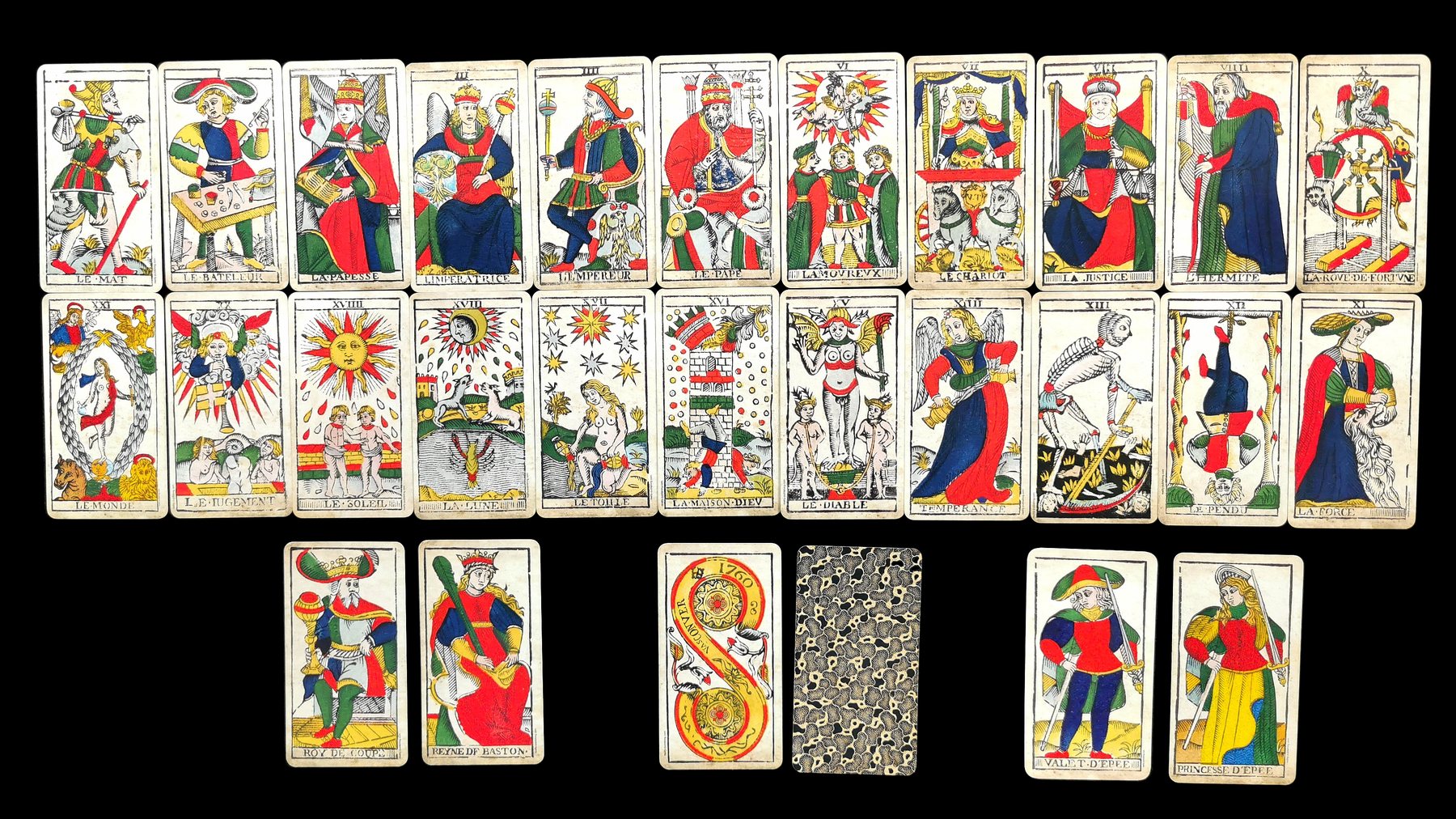
Tarot begins in northern Italy in the middle of the fifteenth century, as a card game. Not a divinatory system, a game, with a fifth suit of trumps added to an existing four-suited deck so that they could beat the other suits. The Visconti-Sforza cards of the 1440s and 1450s are the famous survivors, and they are luxury objects made for a court that liked cards.
The game spread north and west and the imagery standardised. By the seventeenth and eighteenth centuries the pattern we now call the Tarot de Marseille had settled into shape in France and Switzerland: Jean Dodal in Lyon around 1701, Nicolas Conver in Marseille in 1760, and a whole trade of woodblock cutters and card printers producing essentially the same deck with local variations.
Divination arrives late in that story. Court de Gébelin published his claim about Egyptian origins in 1781, which was wrong in every particular and enormously influential. Etteilla, whose real name was Jean-Baptiste Alliette, was the first to build a proper commercial cartomantic system on the tarot in the 1780s. So the cards had existed for roughly three hundred and thirty years before anyone published a method for telling fortunes with them.
And in all that time, and for well over a century after, the minor cards showed exactly what they said they showed. Six coins. Four batons. Nine swords, drawn as nine swords, curved and interlocking, without a weeping figure in a bed.
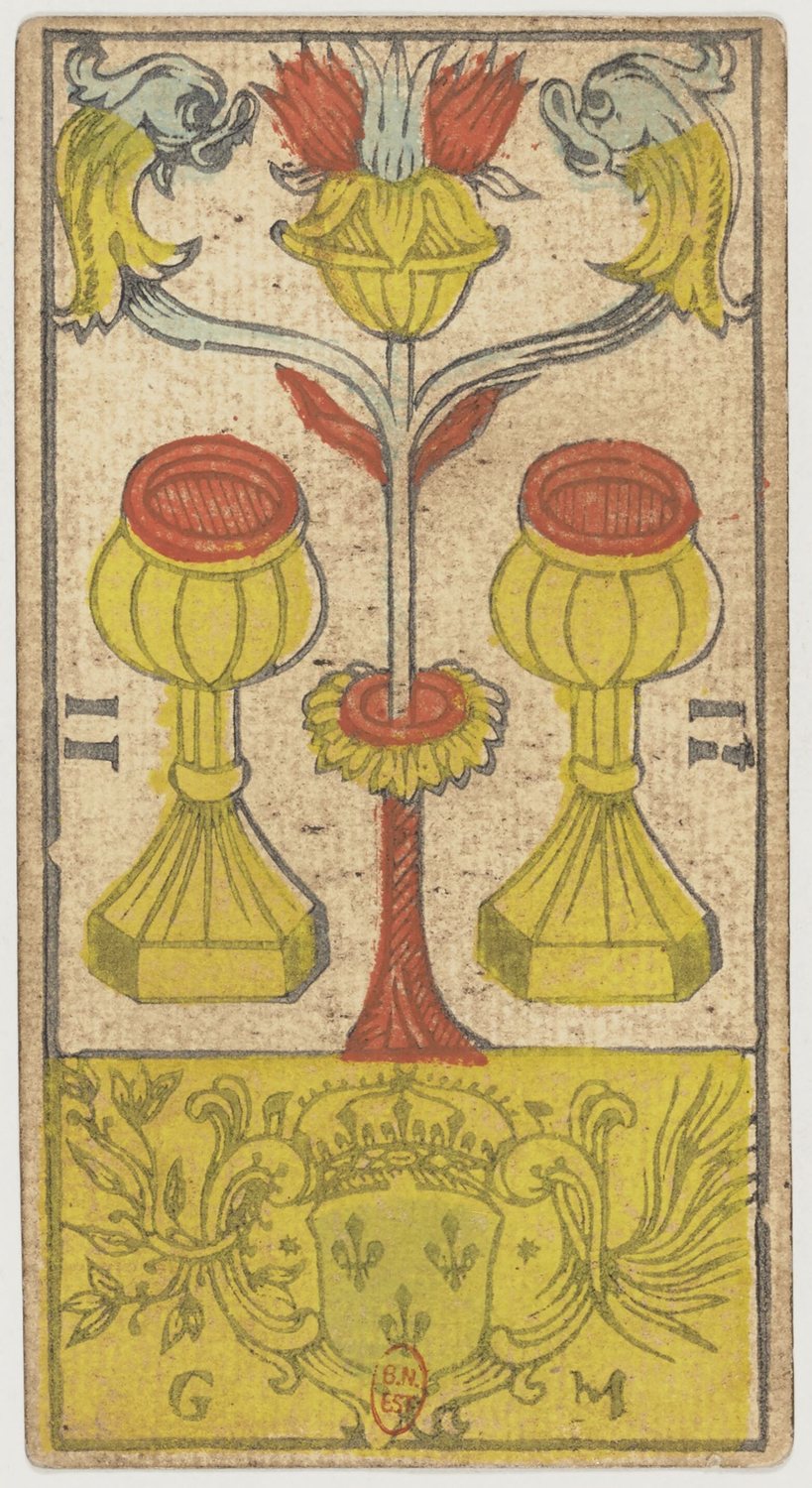
Try it for a moment. Put the card you know in front of you and take the scene off it. Eight cups. That is all you have. No cloaked figure walking away up a hill, no moon, no abandoned shore. Eight vessels, arranged, in the suit of water.
Most readers I put this to go quiet, and then say something about intuition. That is not what the old readers were doing. They were not guessing and they were not waiting to be moved. They were reading a structure, and the structure has three parts.
It was taught. It was written down. It is entirely recoverable, and learning it will make you better at the deck already sitting on your table.