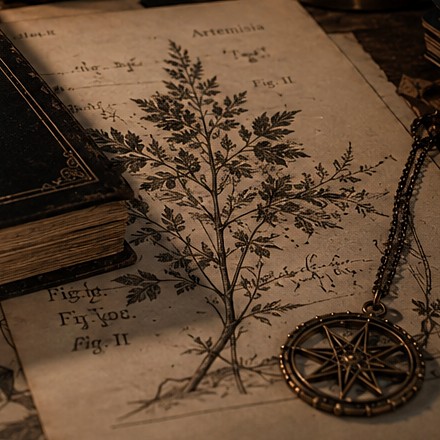
Start with the roadside queen. Mugwort, Artemisia vulgaris, grows where nobody planted her, silver on the underside of the leaf as if the moon had been at the paint. She is named for Artemis, and the associations follow: night, dream, the hunt for what hides. The Anglo Saxon Nine Herbs Charm calls her the oldest of worts, first among the nine, and a thousand years of folk practice agrees. Travellers tucked her in their shoes. Girls wore her at midsummer. Dreamers still sew her into pillows.
In my own practice she is the dream herb before she is anything else. A small pillow of the dried leaf by the bed, or a little of the smoke through a room where divination will happen, and the night gets deeper and more legible. The usual honesty applies: she is kin to ragweed, so the allergic should be careful, she is not for pregnancy, and like every strong plant she prefers relationship to consumption. Know your source, start small, keep notes.
Then the diplomat. Vervain, Verbena officinalis, a modest spike of pale flowers you would walk past without the folklore, and the folklore is immense. Roman priests carried bundles of verbenae to purify altars. Pliny records the Gauls' reverence for it and the ceremony of its gathering. The old names call it herb of grace. It is the herb I reach for when a space, a tool or a situation needs blessing rather than banishing: the peace maker, the herb that sets a table.
The recipe I will not give you
And now the famous one. Everyone finds the flying ointment eventually: the salve the witches were said to rub on skin and broom before the flight to the sabbat. The recipes survive because sixteenth century physicians and demonologists wrote them down, usually to prove the flights were delusion, and the ingredient lists are consistent: belladonna, henbane, mandrake, datura. The nightshades. Plants whose working chemicals are tropane alkaloids.
Here is why this journal will never carry that recipe. The tropanes are genuinely dangerous in a way most baneful folklore is not. The active dose and the lethal dose live close together, the concentration varies plant to plant and season to season, absorption through skin is erratic, and the difference between a vision and a cardiac emergency is not something anyone can eyeball, including the confident stranger selling traditional ointments on the internet. I teach herbcraft to make people safer, not braver. Some doors I will describe and still keep shut.
The scholarship deserves its own honesty too. Almost everything we know about ointment use arrives through hostile witnesses, court records and physicians with a thesis to prove. How many accused women actually used such salves, as opposed to having them invented for their confessions, is genuinely uncertain. The ointment is as much a story about how witches were imagined as about what wise women did.
What the flight is actually for
Because underneath the recipe is a real practice: the journey trance, the deliberate loosening of the senses so that the other landscape can be walked. And that door opens without poison. Drum and rhythm, breath, darkness, fasting held lightly, mugwort's much gentler company, and above all practice, the unglamorous kind, night after night. It is slower than the nightshades. You also get to come home every time, which the old recipes never guaranteed.
So: grow the mugwort, honour the vervain, and let the famous salve stay in the museum case where it belongs. The broom flies perfectly well on breath and drumbeat. The plants that promise shortcuts charge tolls I will not let my students pay.