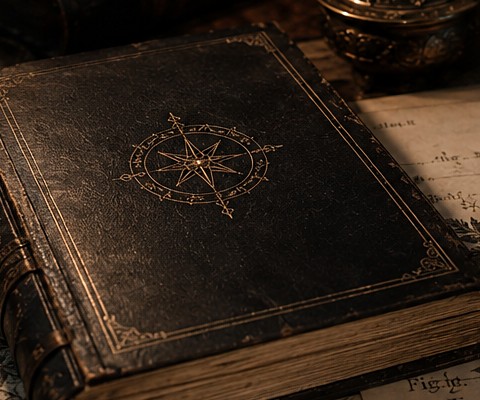
Almost everyone in this tradition meets The Kybalion early. It is short, it is quotable, and it arrives with the perfect costume: a black cover, a Greek sounding name, and the claim of transmitting the hermetic teaching of ancient Egypt through three anonymous initiates. As above, so below, says the poster on a thousand walls, and most people met that sentence here first.
So let us be honest about it, because this library is built on honesty about sources. The Kybalion was published in Chicago in 1908 by the Yogi Publication Society. The three initiates were almost certainly one man: William Walker Atkinson, a phenomenally prolific publisher and author of the New Thought movement, who wrote under at least a dozen names. The style, the ideas and the paper trail all point the same way. It is not ancient Hermetica. It is American mind science of 1908 wearing Egyptian dress.
The seven principles
None of which stops the book from being useful, and here is what it actually teaches. Seven principles: Mentalism, that the all is mind and the universe mental; Correspondence, the famous as above, so below; Vibration, that nothing rests; Polarity, that opposites are the two ends of one thing; Rhythm, that everything swings; Cause and Effect, that nothing merely happens; and Gender, the generative pairing of principles in all things. Seven lenses, stated in aphorisms you can carry in a pocket.
Two of them, in my experience, earn their keep as daily technology. Polarity teaches that fear and courage, hate and love, are not different substances but temperatures on one scale, which means a state can be transmuted by moving along its own scale rather than fighting across to another. And Rhythm teaches that every high swings low and back, which turns despair from a verdict into a tide table. If a student took only those two principles and practised them for a year, the book would have paid its way.
Where it misleads is in its costume. Its Hermes is a stage Hermes. The real Hermetica, the Corpus Hermeticum written in Greek in the early centuries of our era, is stranger, more devotional, less tidy and far less quotable: dialogues about mind, cosmos and rebirth that do not resolve into seven bullet points. And as above, so below has an older home, the Emerald Tablet, where it carries alchemical weight the poster version never hints at. Meet the ancestors and the paperback stops being able to impersonate them.
How to shelve it
So here is how I keep it, and how it sits in my library. The Kybalion is shelved at LL·MS·013, filed honestly under revival, and the Corpus Hermeticum at LL·MS·007, with a free edition linked so you can read the source tonight. Read them beside each other and let each correct the other: the Corpus gives the Kybalion roots and gravity, the Kybalion gives the Corpus handles and daily use.
There is even a lesson in the deception itself. The occult revival invented pedigrees the way other eras invented coats of arms, and the habit still tempts every teacher who wants to seem older than their sources. Naming the 1908 Chicago printing does not diminish the book. It frees it to be what it actually is: a good modern devotional of practical mentalism, and proof that a thing does not need to be ancient to be true. Keep it on the shelf. Just know which shelf.