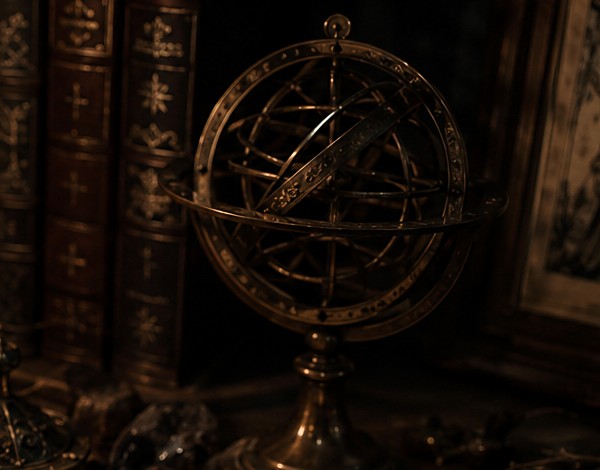
Before the clock flattened time into identical coins, the working day had a different geometry. Take the daylight, sunrise to sunset, and divide it by twelve: those are the day hours. Take the night, sunset to sunrise, and divide by twelve again: the night hours. In summer the day hours stretch long and the night hours shrink; in winter they trade places. Time, in this system, breathes with the year, and every one of those unequal hours belongs to a planet.
The order of ownership is the old Chaldean sequence, from slowest wanderer to swiftest: Saturn, Jupiter, Mars, Sun, Venus, Mercury, Moon, then round again, hour after hour, forever. The first hour of each day belongs to that day's ruling planet, which is precisely why the days are named as they are. Saturday opens with Saturn's hour, Sunday with the Sun's, Monday with the Moon's. Count twenty four hours through the repeating sequence from any dawn and you land, at the next dawn, on exactly the planet the calendar promises. The week you have lived your whole life is a fossil of this system, hiding in plain sight.
Doing it by hand, once
The lineage is long: Hellenistic astrologers built it, the Picatrix times its talismans by it, and nearly every grimoire on my shelves, the Key of Solomon very much included, keys its operations to the hours. Which is to say this is not trivia; for a thousand years it was the standard clock of the art.
Apps will calculate the hours for you in a second, and there is no shame in using them. But do the arithmetic by hand at least once, because the calculation teaches the shape. Say the sun rises at 6:14 and sets at 8:02. That is thirteen hours and forty eight minutes of daylight: 828 minutes, divided by twelve gives day hours of 69 minutes each. The first, from 6:14, belongs to the day's ruler; the second to the next planet in the Chaldean order; and so on round. Ten minutes with a pencil, and the day suddenly has rooms in it.
Using the rooms
Then furnish them. Mercury's hour for writing, correspondence, contracts and study. Venus's for peace making, beauty, love and the arts. The Sun's for visibility, vitality and anything that wants light on it. The Moon's for divination, dream work and the tides of home. Jupiter's for asking, growing and giving thanks. Saturn's for boundaries, endings, wards and the long patient work. Mars I keep for courage and for cutting: the hard conversation, the clean break, the surgeon's errand.
The elegant generosity of the system is that every day contains all seven. Even Saturn's dour Saturday hands you a Venus hour and a Jupiter hour before lunch. Combine day and hour when you can, Mercury's hour on Mercury's day for the important letter, and simply take the nearest good hour when you cannot. It stacks beautifully with the wider art of election, which has its own essay in this journal, for people whose calendars are already full.
One warning, the same one I give about all timing arts: the hour serves the work, never the reverse. If the choice is between the deed done in an ordinary hour and the deed postponed for a perfect one, do the deed. The hours are not a cage. They are what time looks like when you remember it has qualities as well as quantities: not a corridor of identical minutes, but a house with seven rooms, each lit differently, each good for something. Learn the rooms, and the week stops being flat.